
2026 guide for African founders & investors Pan-African expansion hub

Mauritius Investor Permit for African Business Owners (2026)

Whether you are an entrepreneur in South Africa, Nigeria, Kenya or Zimbabwe, Mauritius can be your base for growing across Africa. This guide explains the 2026 EDB rules, how to set up your Mauritian company, how the island's African tax treaties and trade agreements work, and how to live there with your family. Prefer us to handle it end to end? See our Investor Permit Mauritius service.

  • USD 100,000minimum investment USD 50,000
  • 16tax treaties in force with African countries
  • COMESA · SADCplus AfCFTA trade access
  • Up to 10 yrspermit, renewable, with family
  • Free, no-obligation call
  • Reply within 24 hours
  • Fully remote from anywhere in Africa
how to check mauritius work permit online
Written by Nina Bagha • Founder & Director, DNB HR Associates Ltd • Updated October 2026
2026 expansion guide

The Pan-African Expansion Corridor

As African trade accelerates under the African Continental Free Trade Area (AfCFTA), founders, family businesses and corporate executives across Sub-Saharan Africa are looking for a secure, stable and neutral base from which to manage cross-border operations.

For entrepreneurs in high-growth markets such as South Africa, Nigeria, Kenya, Ghana and Zimbabwe, three domestic challenges often hold back international expansion:

  • Currency volatilitySharp swings in local currencies make long-term planning and pricing difficult.
  • Foreign exchange controlsRestrictions on moving funds abroad slow down payments, investment and growth.
  • Regional trade barriersTariffs and paperwork between markets add cost and delay to cross-border trade.

Mauritius is one of Africa's leading international business and financial centres. Positioned between Africa and Asia, it offers political stability, a well-regulated banking system, no foreign exchange controls, and a network of tax treaties with 16 African countries in force.

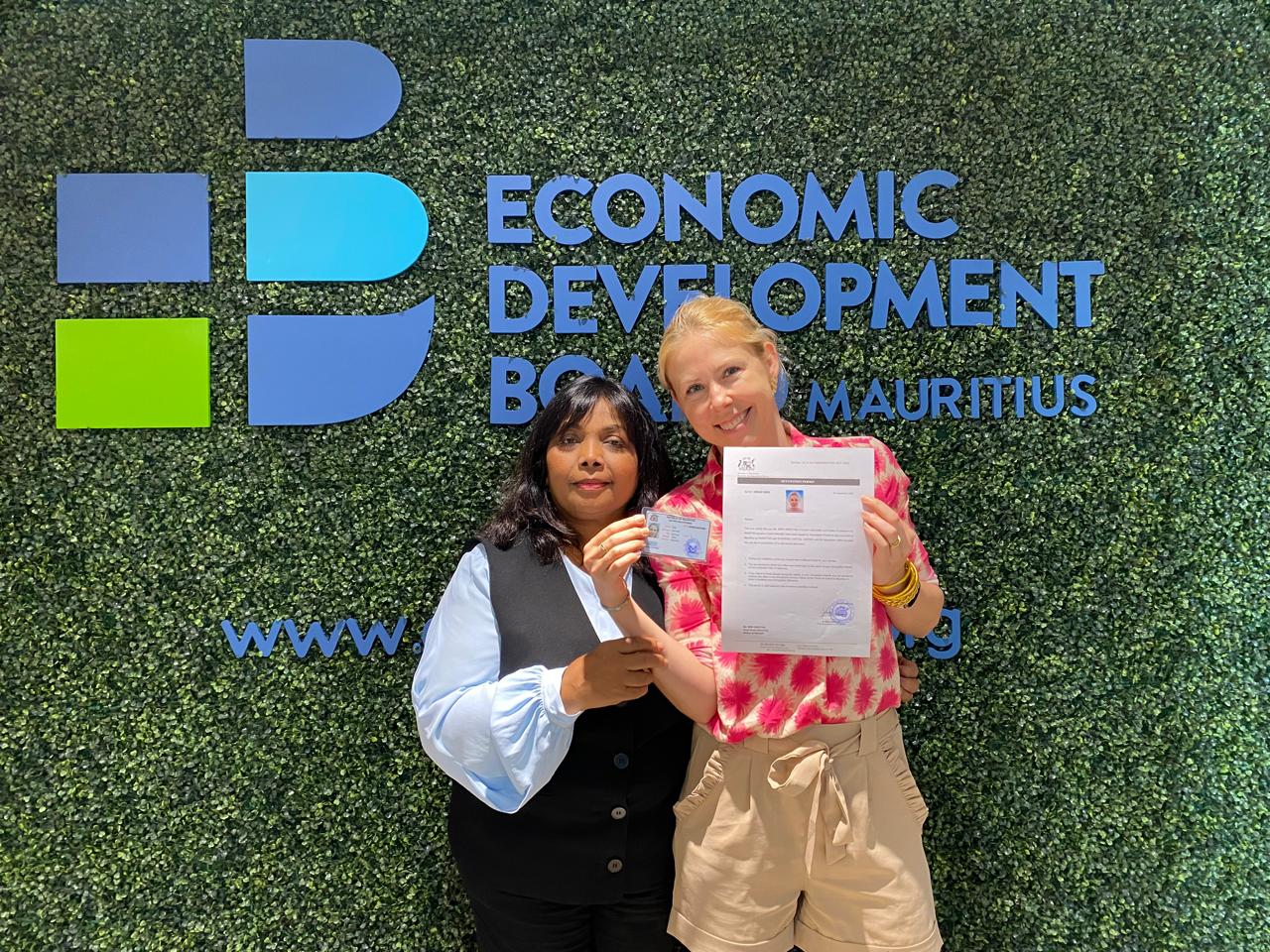
The main gateway for African entrepreneurs is the Investor Occupation Permit: a combined work and residence permit issued through the Economic Development Board (EDB). Granted for up to 10 years and renewable, it lets you live in Mauritius, run your company and bring your family. To have it handled for you, see our Investor Permit Mauritius service.

Investment thresholds

2026 EDB Investment Thresholds & Capital Transfers

The Economic Development Board (EDB) tightened the Investor Permit rules in 2026. These are the two financial tests every African business owner must plan for.

Updated for the 2026 EDB guidelines

Requirement 1

The USD 100,000 initial investment

USD 100,000minimum, or the equivalent in a freely convertible currency USD 50,000 before 2026

You show proof of funds with your application, then transfer the money from your bank outside Mauritius into your newly incorporated Mauritian company's account within 60 days of the permit being issued. Transfers must also follow your home country's exchange control rules, such as the South African Reserve Bank allowances, so plan them with your bank early.

Important: this is not a fee. The USD 100,000 is not a government tax or a lost fee. It is your company's working capital, and you keep full control of it to fund:

  • Operating costs
  • Staff salaries
  • Technology
  • Regional growth
Requirement 2

Turnover performance targets

Your company must show real economic substance by reaching minimum annual turnover levels, declared each year to the Mauritius Revenue Authority.

  1. Years
    1–2
    LaunchBuild the business in line with your plan.
  2. From
    Year 3
    MUR 5M a yearMinimum annual turnover.
  3. From
    Year 5
    MUR 8M a yearMinimum annual turnover to renew your permit.

Planning for a 20-year Permanent Residence Permit? That requires a much higher turnover, so build it into your business plan from day one.

Will your business plan hit these targets?

We review your projections against the 2026 EDB thresholds before you commit any capital.

Source: EDB, "What's New in Occupation and Residence Permits", August 2026. More detail in our 2026 Investor Permit requirements guide. Final decisions rest with the Mauritian authorities.

Country focus

Key Country Focus: South Africa, Nigeria, Kenya, Ghana & Zimbabwe

Every market brings different reasons to set up in Mauritius, and different rules to respect at home. Here is what matters most for founders from five key African economies.

01 · South Africa

Managing SARS compliance & proximity

One of the largest expatriate business communities in Mauritius.

  • Tax alignment: Mauritius can become your new tax residence, provided you exit South African tax residence properly with SARS. The revised South Africa–Mauritius tax treaty decides where income is taxed.
  • Proximity: direct flights from Johannesburg take around four hours, so you can keep managing South African operations closely.

Plan your SARS exit: ceasing South African tax residence can trigger an exit charge on your worldwide assets. Take advice from a South African tax practitioner before you move.

✓ Tax treaty in force
02 · Nigeria

Currency stability & a global trade gateway

A stable base for Nigerian founders and tech entrepreneurs.

  • No exchange controls in Mauritius: hold, convert and repatriate USD, EUR and GBP freely, a strong buffer against naira volatility.
  • Investment-ready structures: Mauritian companies are widely used by African tech ventures raising regional and international funding.

Good to know: the Nigeria–Mauritius tax treaty is signed but not yet in force, and moving funds out of Nigeria must follow Central Bank of Nigeria rules.

⏳ Treaty awaiting ratification
03 · Kenya & East Africa

A regional base for treasury & trade

Air links between Nairobi and Sir Seewoosagur Ramgoolam International Airport keep East Africa close.

  • Treasury & trade centre: East African executives use Mauritius to manage cross-border payments, contracts and regional services.
  • Treaty network: Mauritius has treaties in force with East African partners such as Uganda and Rwanda, useful for structuring services and investment in the region.

Kenya–Mauritius tax treaty: signed but not yet in force. Until it is, Kenyan and Mauritian domestic tax rules apply in full, so plan your structure with that in mind.

⏳ Kenya treaty awaiting ratification
04 · Ghana & Zimbabwe

Trade structuring & access to stable banking

A secure base for international trade and commercial assets.

  • Trade structuring: manage international contracts, invoicing and supply chains from a stable, well-regulated jurisdiction.
  • Stable banking: access to Mauritian and international banks with multi-currency accounts.
  • Treaty protection: Mauritius has tax treaties in force with both Ghana and Zimbabwe.
✓ Tax treaties in force with both

Mauritius tax treaties with African countries: where they stand

Mauritius has tax treaties in force with 16 African countries. Here is the status for the five markets in this guide.

CountryTreaty with MauritiusWhat it means
South Africa✓ In forceRelief from double taxation; residence rules decide where you are taxed
Ghana✓ In forceRelief from double taxation on cross-border income
Zimbabwe✓ In forceRelief from double taxation on cross-border income
Kenya⏳ Awaiting ratificationNot yet applicable; domestic tax rules apply
Nigeria⏳ Awaiting ratificationNot yet applicable; domestic tax rules apply

Substance matters: a Mauritian company that is in practice managed from your home country can be taxed there. Board decisions and management must genuinely happen in Mauritius, which we help you set up through company registration in Mauritius.

Get advice for your country, not a template

Tell us where you operate today. We map out the right Mauritius structure, your Investor Permit and the home-country points to clear with your adviser.

Treaty status as listed by the Mauritius Revenue Authority, October 2026. General information only, not tax or legal advice: take advice in your home country before relocating.

From your market to Mauritius

Step-by-Step Application Roadmap

Expanding from an African market to Mauritius follows a structured four-stage process. Almost all of it can be handled while you keep running your business at home.

  1. Step 1Business plan & company setup
  2. Step 2Bank account & capital transfer
  3. Step 3Online filing via NELS
  4. Step 4Approval & permit in Mauritius
  1. CBRIS & BRNRemote

    Business plan & incorporation via CBRIS

    DNB drafts an EDB-compliant business plan setting out your projected growth and trade strategy, with turnover projections towards the 2026 turnover targets.

    At the same time, your company is registered through the Companies and Businesses Registration Integrated System (CBRIS), giving you your Certificate of Incorporation and Business Registration Number (BRN). Company registration in Mauritius →

  2. BankingRemote

    Corporate banking & capital transfer

    Once incorporated, your company opens a corporate account with a Mauritian bank. You provide proof of funds and a written undertaking to transfer the USD 100,000 with your application. The capital can come from your home country or from an existing corporate account abroad, following your home country's exchange control rules.

    When the money moves: the USD 100,000 is transferred to your Mauritian company account within 60 days of the permit being issued, not before you apply. Start any exchange control approvals at home early.

  3. NELSRemote

    Online filing via the NELS portal

    Your permit application is submitted remotely through the National E-Licensing System (NELS), overseen by the EDB. The non-refundable USD 50 application fee is paid at this stage.

  4. AIP · 15–20 working daysIn Mauritius

    Approval in Principle & relocation

    The EDB typically reviews a complete file within 15 to 20 working days. Once you receive your Approval in Principle (AIP) letter, you have 90 days to travel to Mauritius and complete the local formalities:

    1. A routine medical check-up at a medical facility in Mauritius
    2. Verifying your original documents, including your passport and a police clearance certificate from your home country, at the Passport and Immigration Office in Port Louis
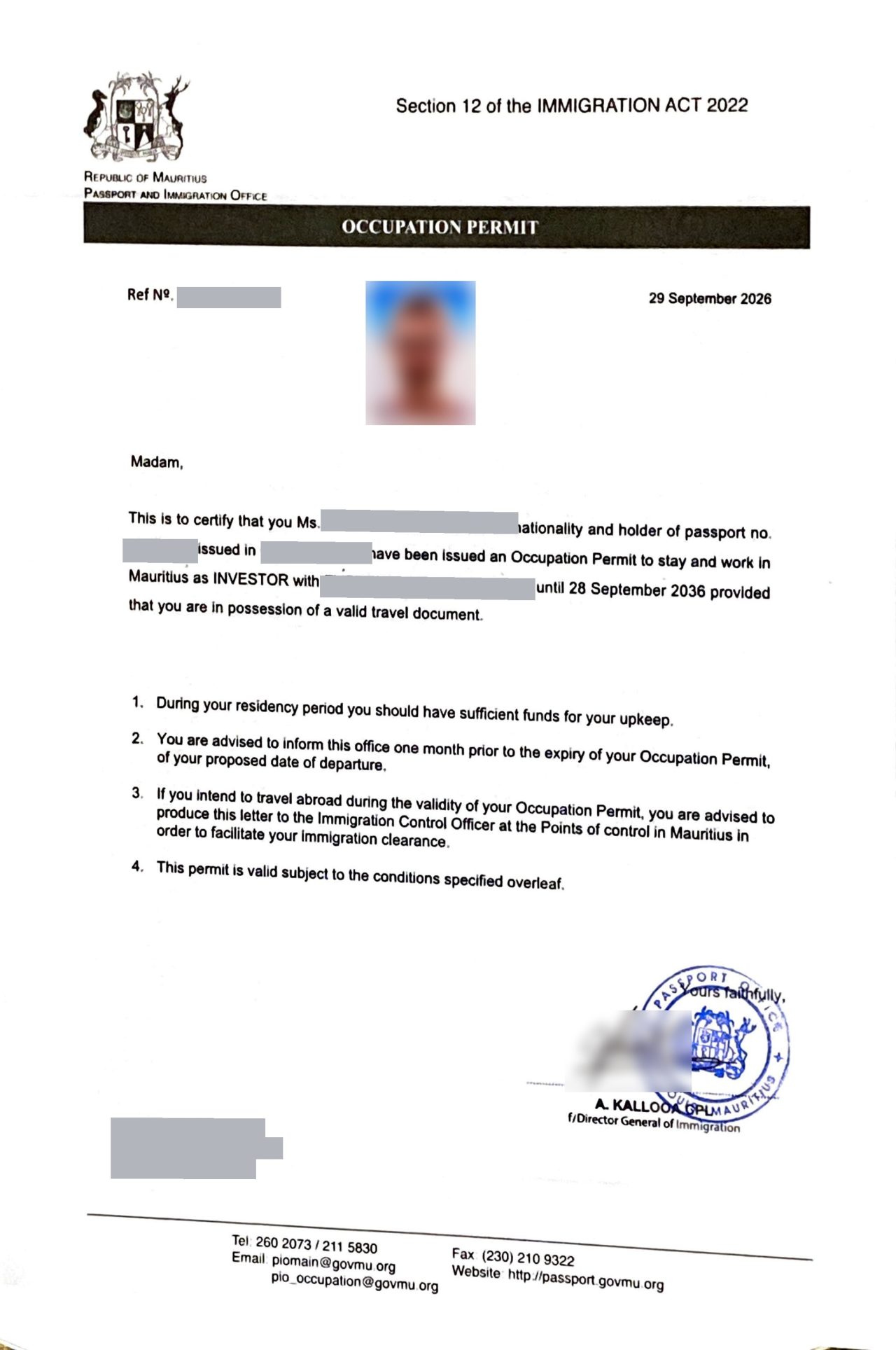
    3. Collecting your Investor Occupation Permit, valid for up to 10 years

    Travelling to Mauritius: entry rules for visits depend on your nationality; many African passport holders can visit without a visa arranged in advance. We confirm the rules for yours. A visitor entry does not allow you to work: you start operating once your Occupation Permit is issued.

    Bringing your family? Their permits are prepared alongside yours. Planning ahead? Read about permanent residency in Mauritius.

We coordinate all four steps for you

Company, bank account, NELS filing and appointments in Port Louis: DNB manages the whole process from Ebène while you keep your business running at home.

Timelines are indicative and depend on your file and on the authorities' workload. Procedures and fees may change; approval rests with the Mauritian authorities.

Common questions

Frequently Asked Questions

The questions African founders and business owners ask us most often about expanding to Mauritius.

Can I apply for the Mauritius Investor Permit from my home country in Africa?
Yes. Company incorporation through CBRIS, business plan preparation and the EDB application on the NELS portal are all handled remotely. You only travel to Mauritius after receiving your Approval in Principle (AIP), within 90 days. See the step-by-step roadmap.
Do South African, Kenyan, Nigerian, Ghanaian or Zimbabwean passport holders need a visa to visit Mauritius?
Most African passport holders, including citizens of these five countries, can enter Mauritius either visa-free or with a visa issued on arrival for short visits such as business meetings and your final permit formalities. Conditions and lengths of stay vary by nationality, so confirm the current rules for your passport before travelling. A visitor entry does not allow you to work.
Can my Mauritian company trade back into my home country?
Yes. Your Mauritian company can trade actively across African markets. Where a tax treaty is in force, it relieves double taxation; trade agreements such as COMESA, SADC and the AfCFTA can offer preferential access, subject to their rules of origin. Your home country's own tax rules still apply to income earned there, and a company effectively managed from your home country can be taxed there. See the treaty status table.
Is there a tax treaty between Mauritius and Kenya or Nigeria?
Both treaties have been signed but are still awaiting ratification, so they are not yet in force. Until they are, Kenyan, Nigerian and Mauritian domestic tax rules apply in full. Mauritius does have treaties in force with 16 African countries, including South Africa, Ghana, Zimbabwe, Uganda and Rwanda.
How do I transfer the USD 100,000 if my country has exchange controls?
The transfer must follow your home country's exchange control rules, such as the South African Reserve Bank allowances or Central Bank of Nigeria procedures. It is made within 60 days of your permit being issued, so start any approvals with your bank early. The funds can also come from an existing corporate account abroad. See the 2026 investment thresholds.
How long does the process take?
Typically 2 to 4 months from preparing your business plan to collecting your permit. The EDB usually issues Approval in Principle within 15 to 20 working days of a complete application.
Can my family move to Mauritius with me?
Yes. Your spouse or life partner, unmarried dependent children and dependent parents can apply for residence permits linked to your Investor Permit, for the same duration. See family and permanent residence.
Africa to Mauritius

Expand Your African Business with Confidence

Moving your business headquarters to Mauritius gives you a secure platform for long-term growth. DNB HR Associates is a Mauritius-based team offering end-to-end support with company formation, EDB compliance, corporate structuring and residency coordination.

From your first call to your permit in hand, our team in Ebène works with you and your home-country advisers every step of the way. Learn more about our Investor Permit Mauritius service.

Book a confidential strategy session Speak directly with an expansion adviser in Ebène, Mauritius. Free, with a reply within 24 hours. Schedule an Investor Consultation
Check your eligibility Our online assessment gives an initial indication of your fit for the Investor Permit in 5–7 minutes. Free preview; full result USD 49. Check Your Investor Permit Eligibility
  • Fully remote, wherever you are in Africa
  • Team based in Ebène, Mauritius
  • Prefer WhatsApp? Message us

General information only, not tax or legal advice. Approval of all permits rests with the Mauritian authorities.

DNB HR ASSOCIATES Mauritius Permit
Eligibility Check
QUESTION 7 OF 12

What best describes your current position?

I have a Mauritius job offer
I am planning a business project
I work independently
I plan to retire in Mauritius
Continue →
Your pathway, made clearer

A guided assessment built around your real plans

The DNB assessment turns broad ambitions—such as moving, working or starting a business in Mauritius—into a clearer starting point for the right permit conversation.

Five pathways considered

Investor, Professional, Self-Employed, Retired Non-Citizen and Young Professional.

Personalised indication

Your answers shape the pathway direction and the next factors to explore.

Simple, focused questions

Designed for people who do not yet know the technical permit terminology.

Private next step

Use the result to explore the right route or request confidential DNB guidance.

Nina Bagha

Nina Bagha

Nina Bagha Founder & Director, DNB HR Associates Ltd Founder & Director, DNB HR Associates Ltd Nina Bagha is the Founder and Director of DNB HR Associates Ltd, a Mauritius-based HR consultancy providing human resource, business setup and immigration support services. Through DNB HR Associates, she works with international investors, professionals and businesses seeking to establish or expand their presence in Mauritius, including support with company setup and Occupation Permit applications.

Personalised Immigration Guidance

Need Personalised Advice?

Every investor's circumstances are different. The pathway to permanent residence involves business performance, documentation, and timing considerations that are best assessed against your specific situation.

Our Mauritius-based team can help you plan your long-term strategy, from the initial Investor Occupation Permit through to permanent residence.

Contact DNB HR Associates →

Our Happy Clients